Preparing Future Heirs of Family Wealth
Receiving family wealth creates one of the most important new life contexts a person will ever experience.
We help prepare future heirs for the responsibilities, emotions, decisions, and challenges that come with it.
Families devote years preparing the legal, financial, and tax aspects of wealth succession.
Yet many wealth creators remain concerned that the heirs who will eventually inherit that responsibility may not be fully prepared to steward it.
A Prefictive Operating Model can be intentionally developed before the responsibility arrives.
A Critical Blind Spot in Heir Preparation
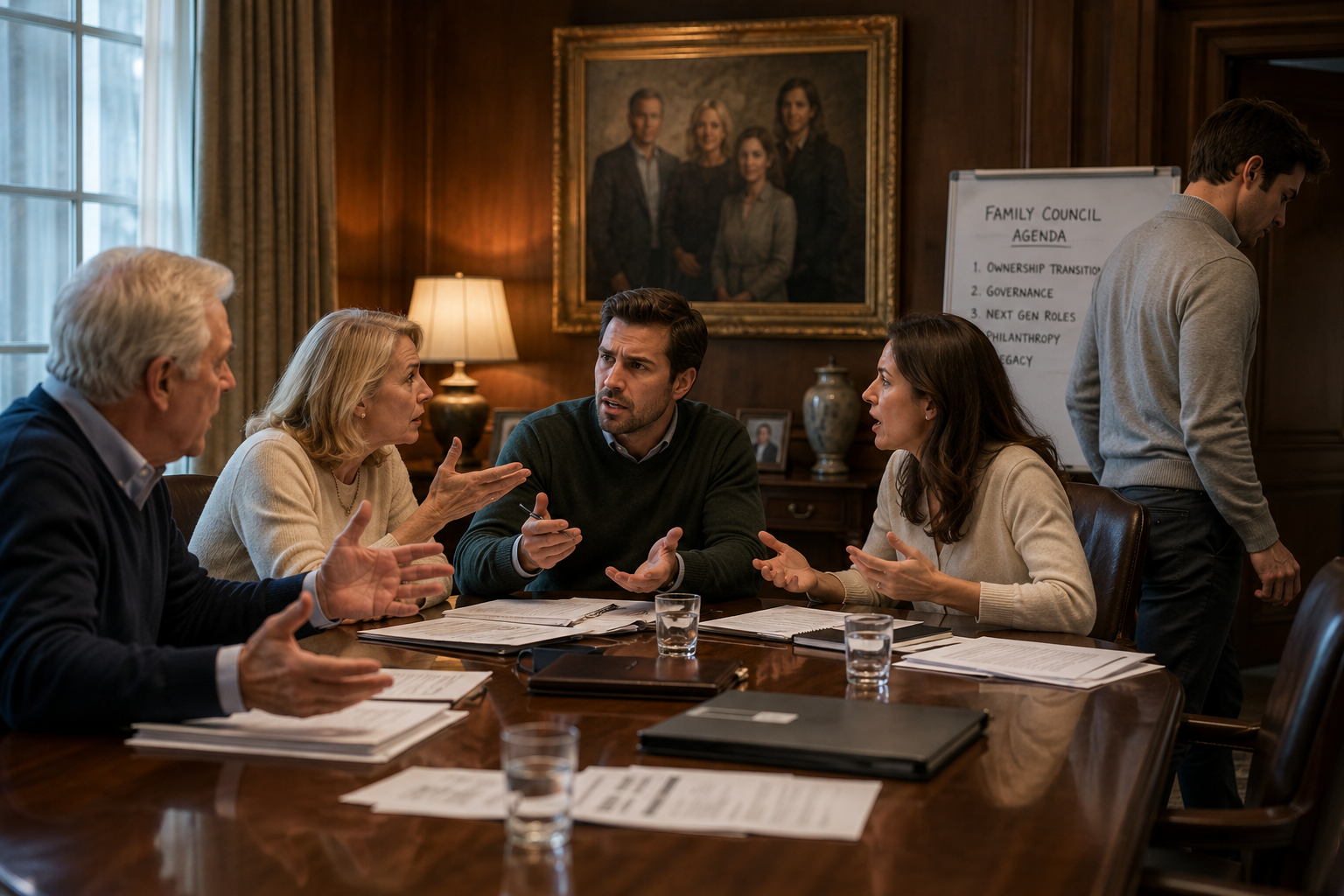
Receiving family wealth doesn't simply change what someone owns.
It changes how they experience their life.
New responsibilities.
New expectations.
New relationships.
New freedoms.
New decisions.
In other words...
It creates an entirely new life context.
Families invest significant time and resources preparing the legal, financial, tax, governance, and educational aspects of transferring wealth.
Those investments are essential and should continue.
Yet many wealth creators still wonder:
"Are my children fully prepared to become responsible stewards of what I've spent a lifetime building?"
That concern is justified.
Recent research¹ suggests that only about one in four wealth creators believe their heirs are very prepared to receive and manage their inheritance.
Research² examining unsuccessful wealth transitions has also found that the primary contributing factors are overwhelmingly human —
including breakdowns in trust and communication and heirs who are insufficiently prepared mentally and behaviorally for stewardship.
The common thread is that these challenges aren't problems of legal structures, investment management, or tax planning.
They are human challenges.
We believe one important dimension of heir preparation has received far less attention than the others:
Preparing the brains of the people who will inherit and steward the wealth.
Sources
¹ RBC Wealth Management. A Generational Look at the Great Wealth Transfer (2025).
² Roy Williams & Vic Preisser, Preparing Heirs; The Williams Group family wealth transition research.
What If We've Been Viewing Heir Preparedness Through Only One Lens?
For decades, heir preparedness has focused primarily on
financial literacy estate planning tax planning governance and investment education.
These are all essential.
The expectation is that, once future heirs have been taught the knowledge and principles of wealth stewardship, their brains will naturally generate the ways of thinking, interpreting, deciding, and behaving those lessons were intended to produce.
Modern neuroscience suggests that isn't how the brain works.
When an individual suddenly becomes responsible for significant family wealth, their brain enters a context it has never experienced before.
None of these forms of preparation determine which predictive operating model the brain will recruit when that responsibility finally becomes real.
The brain does.
Preparing an Heir Requires More Than Technical Preparation
Technical Heir Preparation
Teaches financial knowledge
Teaches governance principles
Teaches investment and estate concepts
Explains what responsible wealth stewardship looks like in theory
Human Heir Preparedness
Develops Wealth Ownership Identities
Prepares the brain for future wealth stewardship contexts
Develops ways of thinking, interpreting, deciding, and behaving as a steward
Increases the likelihood the brain will generate responsible wealth stewardship experiences when the responsibility becomes real
What determines how an heir will respond to inheriting wealth?
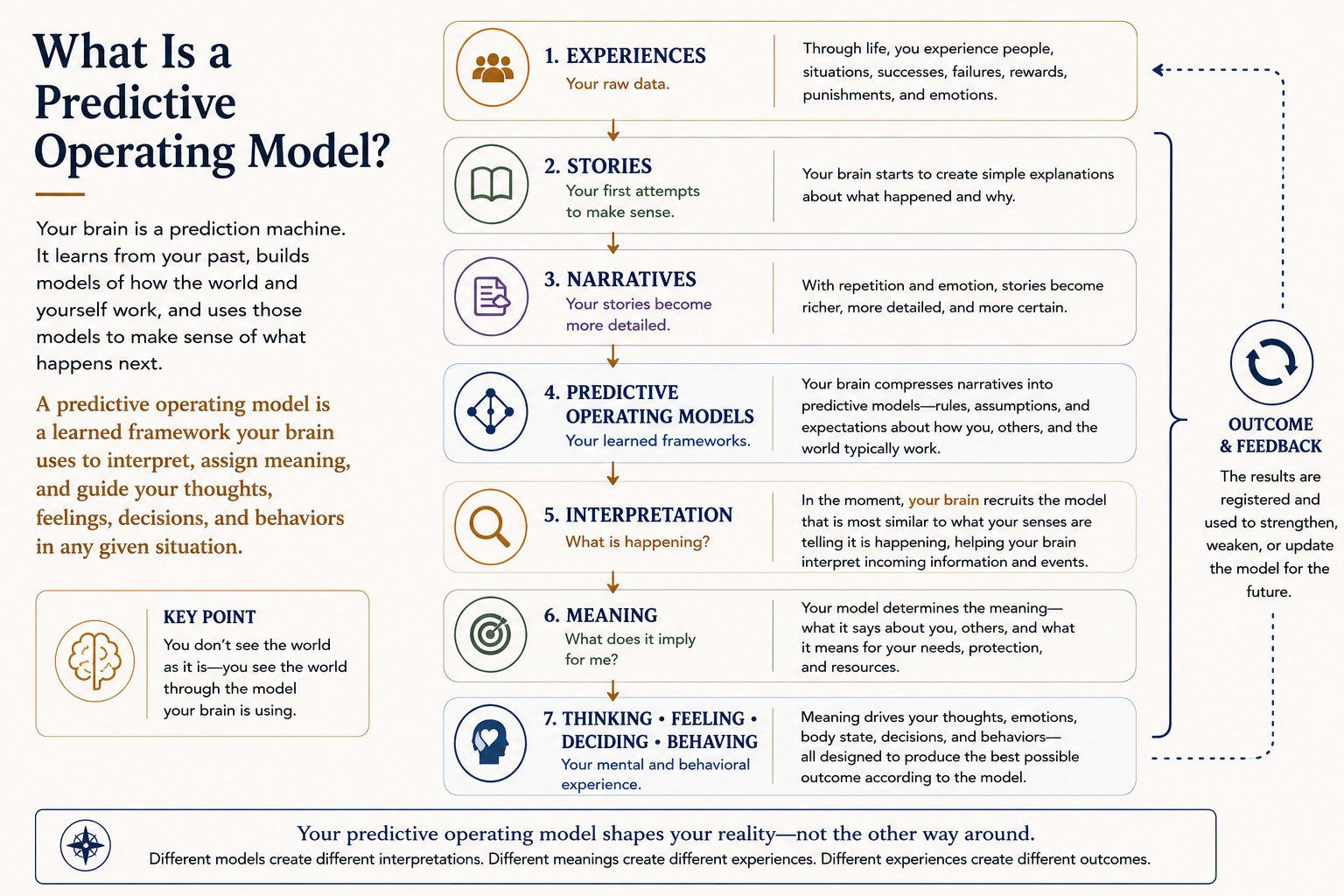
Modern neuroscience suggests that our brains don't create our thoughts, emotions, decisions, and behaviors from scratch every time we encounter a situation.
Instead, the brain relies on predictive operating models (stored interconnected information) constructed from our past experiences that occurred in similar situations - to predict just moments before reality unfolds - how we should respond .
A predictive operating model is the brain's learned framework for anticipating what situations mean, what is likely to happen next, and how to think, feel, and behave in response.
Everything we experience is a prediction by the brain
When someone inherits family wealth, the brain doesn't suddenly invent a new way of thinking, emoting and behaving, just because you have been teaching it the technical aspects of stewarding wealth.
Instead, it recruits the operating model it has already constructed that resembles this context, and helps the brain achieve it’s core objectives - protection, low cost, fulfilling needs.
But - since the brain has never owned inherited wealth before - there is no model built for it.
So which model will the brain recruit and what outcomes will be generated by the model?
Being educated in wealth ownership doesn’t necessarily mean that education makes it’s way into the operating model the brain will recruit when the wealth transfers.
So how do we intentionally build an operating model for responsible wealth stewardship before the wealth transfers?
What Happens When Family Wealth Becomes Their Responsibility?
Becoming responsible for family wealth is a completely new life context in someone’s life - even if you’ve lived amongst that wealth your entire life.
The brain has never “experienced” what it means to think, decide, and behave as an owner and steward of inherited wealth -
it may have lived around family wealth for years, but it has never experienced owning it or being responsible for stewarding it.
When the brain encounters a novel context (like suddenly inheriting and owning wealth), it doesn't automatically create a new predictive operating model for the context.
Operating models in the brain are built over time through repeated experiential exposure to the context.
What does the brain do when it doesn’t have an operating model for a life context like owning and stewarding inherited wealth?
It searches for the closest match from other life experiences.
Unless the brain has already developed operating models for the responsibilities of owning family wealth, it will recruit operating models from other life experiences that it predicts will work best in this new context.
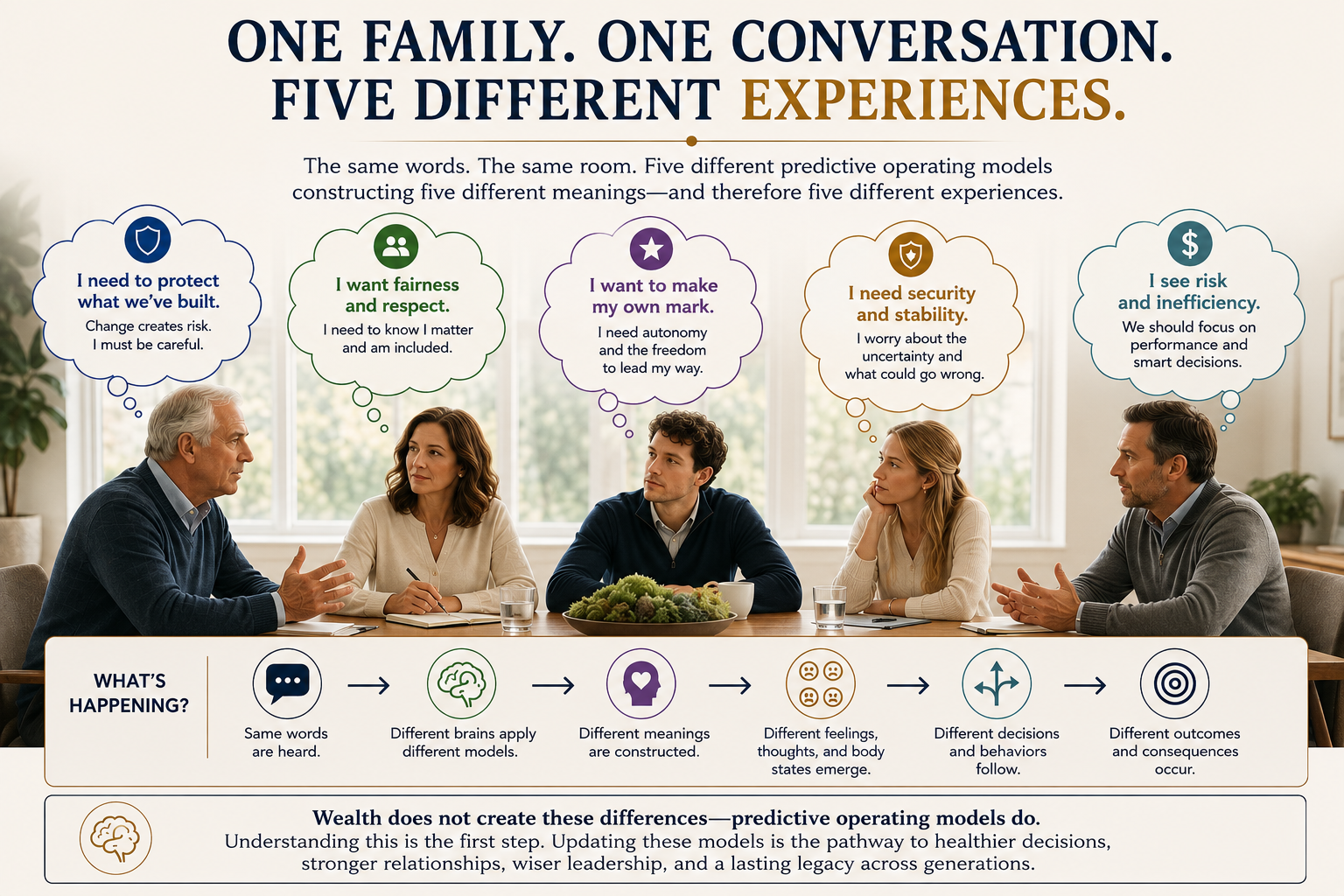
Operating models — originally developed from entirely different contexts — such as
proving oneself avoiding conflict seeking approval protecting against failure or pursuing significance
— may be recruited because they appear most similar to the new responsibility.
Those operating models were never developed for owning and stewarding inherited wealth.
When the brain predicts one of these operating models offers the highest expected value in the context of inherited wealth, it recruits that model.
That model then shapes how the individual interprets the responsibilities of ownership, makes decisions, responds to uncertainty, and relates to other family members.
Can Stewardship Preparedness Be Intentionally Developed?
Yes, it can.
Just as the brain learns operating models from experiences throughout life, it can also intentionally develop and reinforce new operating models before important future responsibilities (new contexts) arrive.
Rather than waiting until wealth has been transferred to discover which operating models the brain recruits, stewardship preparation begins by helping future stewards anticipate the contexts they are likely to encounter.
Together, we identify the existing operating models that may be recruited, evaluate the future consequences they are likely to produce, and potentially develop a new stewardship operating model designed specifically for the responsibilities that lie ahead.
The goal is not to predict the future.
The goal is to increase the likelihood that, when stewardship responsibilities become real, the brain will recruit an operating model intentionally developed for stewardship rather than one recruited from an unrelated area and time of life.
Our Stewardship Preparedness Framework
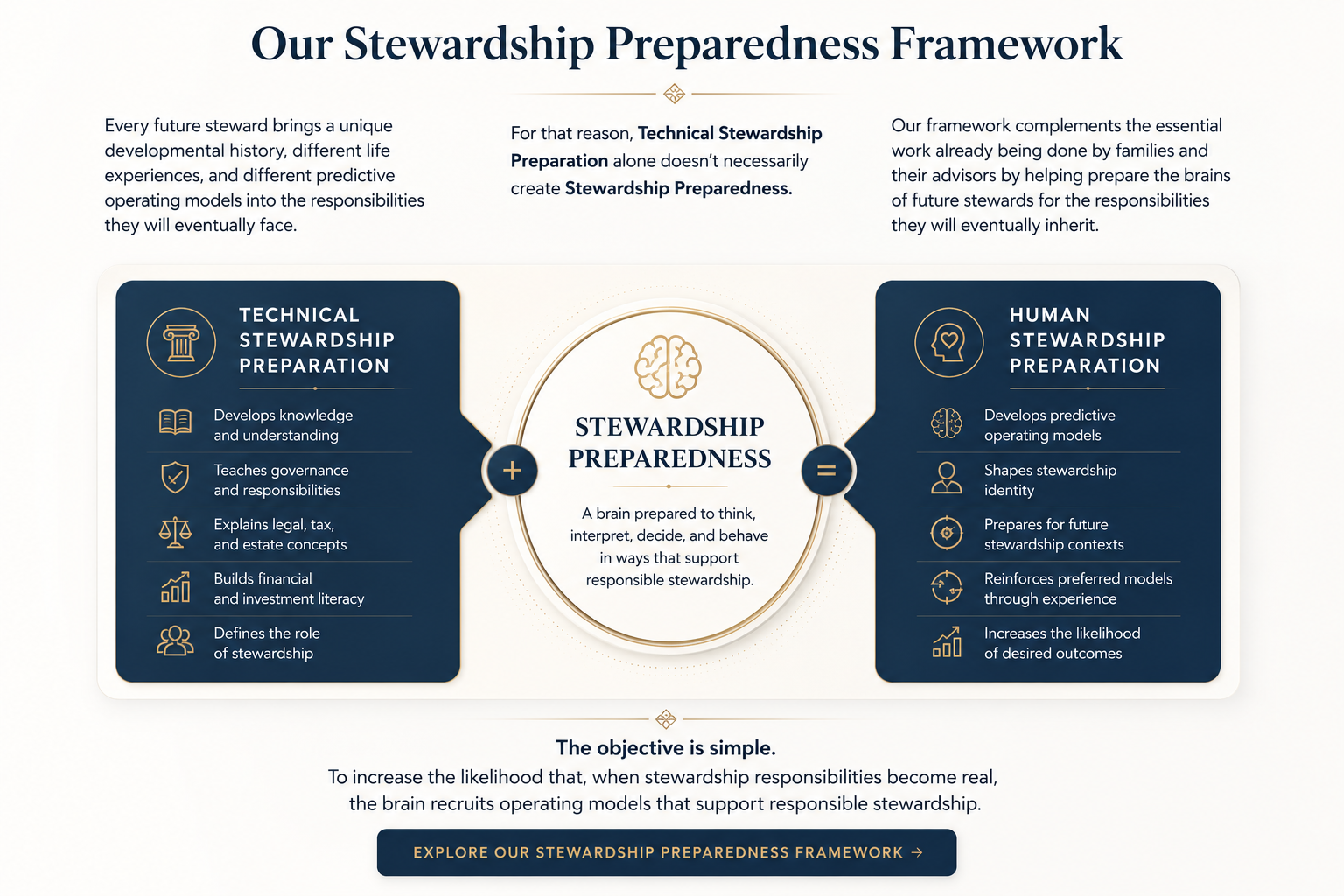
Every future steward brings —
a unique developmental history different life experiences and different predictive operating models
— into the responsibilities they will eventually face.
For that reason,
Technical Stewardship Preparation alone doesn't create Stewardship Preparedness.
Our framework complements the essential work already being done by families and their advisors by helping prepare the brains of future stewards for the responsibilities they will eventually inherit.
The objective is simple.
To increase the likelihood that, when stewardship responsibilities become real, the brain recruits operating models that support responsible stewardship.